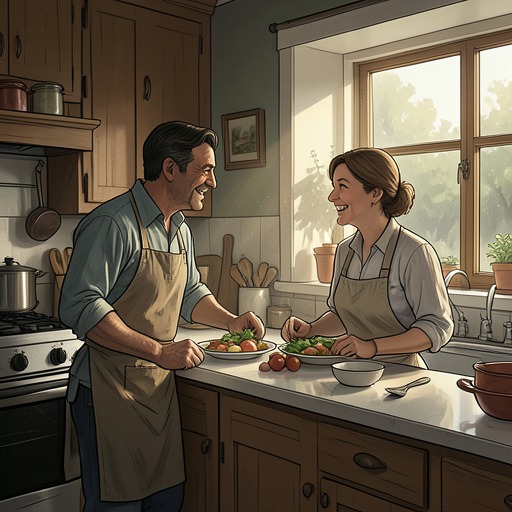
Pop and Ma decide not to marry for now
The Darling Buds of MayPop and Ma decide not to marry for now, making a practical choice that leaves their long-standing family life unchanged even as another baby is expected. Their decision turns on tax advice from Cedric Charlton, but it also brings into view a larger tension in the story: the household functions as a family without marriage, while public institutions continue to make legal status matter.
The proposal
The possibility of marriage emerges at home from a small physical detail. As Ma fingers turquoise rings that seem to be growing tighter, Pop connects them to the possibility of marrying. He suggests that, if her condition continues, they may have to marry; Ma answers that it might not be a bad idea and adds that her rings will have to be cut off again anyway. The casual exchange is not a formal proposal so much as a tentative opening: marriage enters their conversation through the ordinary circumstances of Ma’s pregnancy and the rings on her fingers.
The prospect is sharpened by the family’s news about Mariette and Cedric. After Pop affectionately kisses Mariette and Ma kisses both her daughter and Cedric, Pop says that he and Ma have news of their own: they had thought they would marry, and Ma is going to have another baby. The announcement places the two generations’ changing family lives side by side. Yet Cedric, who had once been likely to find such news startling, now responds by saying that the matter needs thought. His objection does not concern their affection or their household; it is explicitly about the tax situation.
Tax advice and the decision
Cedric explains that, financially, it does not pay for Pop and Ma to marry. He begins to say that it pays to live together without marriage, then checks himself before completing the phrase; Ma is offended by the implication and tells him not to use the word she knows he was about to say. He apologizes and restates the point more tactfully: he would advise them to keep the status quo. The choice is thus presented not as a rejection of their relationship but as an assessment of the costs attached to changing its legal form.
Pop tests the advice against the life they already have, asking whether they are quite happy as they are and whether there is anything to worry about. Ma can think of nothing. He then settles the question in the language of continuity, deciding that they should go on in the old way, and Cedric agrees. Cedric adds that remaining as they are will leave them better off when the time comes to pay tax. Pop asks what time he means; Cedric answers that the tax will catch up with them some day. The warning gives the scene its dry edge: the decision preserves their present advantage, but does not make the underlying obligation disappear.
Family life beyond marital status
The decision rests on a distinction between being a family and being married. Pop and Ma already share a household and raise children together; Ma’s pregnancy makes their continuing partnership especially visible, but does not by itself settle whether they will formalize it. In an earlier exchange with Cedric, Ma insists that Pop is not a dealer but a landowner, while Pop calls himself a farmer. That insistence on naming his actual position echoes the later insistence that the couple’s existing arrangement should be judged by how they live, not simply by whether they marry.
The practical complications of unmarried status return when the family plans to travel to France. Cedric reminds them of the delicate situation concerning Pop and Ma, and suggests that perhaps it would have been better to marry after all. Pop says that they still could, but shows little enthusiasm, calling it a palaver. Cedric proposes that the children travel on Pop’s passport while Ma obtains her own in her maiden name. When Ma identifies herself as Flo Parker, Pop is painfully startled, as though hearing the name introduces him to her afresh. Her response that things will sort themselves out in the wash leaves the paperwork unresolved, but makes clear that the family’s self-understanding and the state’s categories do not neatly coincide.
Consequences and significance
The immediate outcome is a decision to continue as before, not a declaration that marriage is impossible or permanently refused. Pregnancy prompts the question, and Cedric’s counsel determines the practical answer for the moment. Later, the passport problem shows that the choice has consequences beyond tax: the family must reckon with how an unmarried partnership is represented in official documents, including Ma’s separate passport and maiden name.
The episode also forms part of the family’s uneasy relationship with taxation. Cedric has been the person who understands forms and returns, while Pop treats the tax system as a nuisance to be evaded or outmanoeuvred. Pop had earlier failed to submit an income return, and he urges Cedric to take advantage of the national health service rather than let contributions go unused. In that context, Cedric’s advice about marriage is both intimate and administrative: his knowledge helps the household make a decision about its private life in response to public rules. The unresolved prospect of tax catching up with them prevents the arrangement from appearing consequence-free, while the later passport discussion shows that preserving the old way leaves the family to manage the legal distinctions it has chosen not to erase.